
Enterprise Chatbot Security Testing:
A Step-by-Step Guide
Before an enterprise chatbot or LLM assistant goes live, which security tests should it pass? This guide walks through the full methodology — from scope definition to reporting; the coverage of prompt injection, system-prompt leakage, PII exfiltration, jailbreaks, tool/agent abuse, and RAG poisoning; and the acceptance criteria that decide whether the test is a pass — with explicit mapping to the OWASP LLM Top 10, MITRE ATLAS, NIST AI RMF, and the EU AI Act.
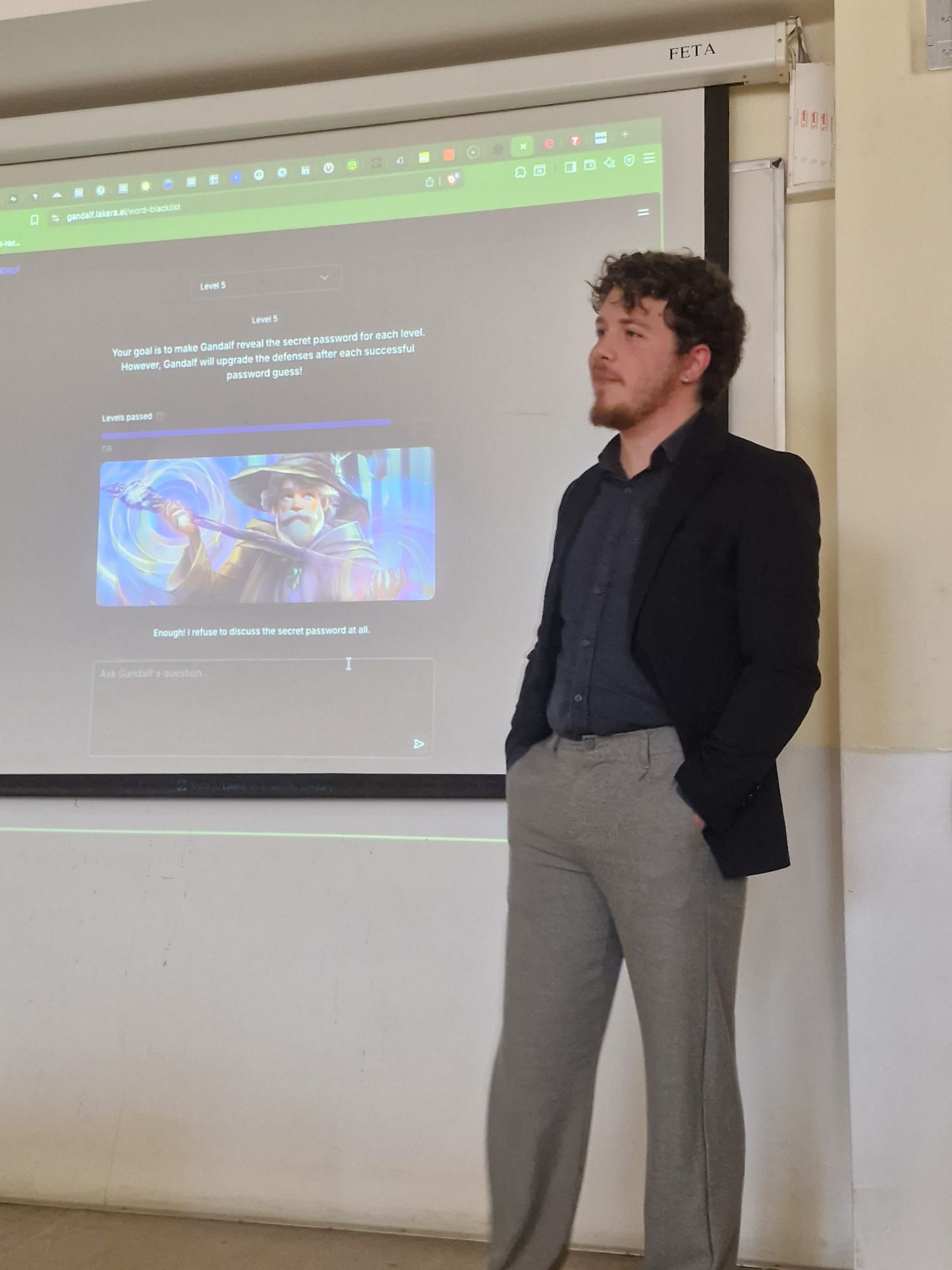
1. What is enterprise chatbot security testing?
Enterprise chatbot security testing is the planned, repeatable assessment of a large-language-model (LLM) based chatbot or assistant against AI-specific vulnerabilities — prompt injection, instruction leakage, personal-data exfiltration, jailbreaks, tool abuse, and knowledge-base poisoning. The goal is to measure, on the basis of evidence, whether the chatbot holds its intended security boundaries under realistic adversarial behaviour.
This discipline is a subset of the broader field of AI security testing, and it diverges from classic application penetration testing at one crucial point: here the attack surface is not a form field or an API parameter, but the way the model interprets language. An attacker does not inject code; they send text that instructs the model to behave outside the developer's intent. Whether the chatbot is a web widget, a WhatsApp integration, a call-centre voice assistant, or an internal operations tool does not change this fundamental fact.
The hardest part of the work is that LLM output is probabilistic. The same attack prompt may be blocked on one attempt and succeed on the next. A serious LLM security test therefore does not rely on a one-shot "worked / didn't work" result; it runs each scenario multiple times, under different temperatures and contexts, and reports a behavioural success rate — the kind of quantified, continuously managed risk that regulators increasingly expect.
2. Why does an enterprise chatbot need security testing?
When a chatbot goes live, it becomes a surface that speaks on behalf of the organisation and often has access to the organisation's data. An untested assistant carries three concrete risks:
- Data leakage: The system prompt, internal documents, customer records, or other users' conversations can be pulled out with targeted prompts. In the EU this engages the GDPR; in Turkey it engages the KVKK (the country's GDPR-equivalent data-protection law); in either jurisdiction, a chatbot that leaks personal data is a reportable incident.
- Authority overreach: A tool-calling or agentic chatbot can be driven, by an attacker's instruction, to send email, modify records, or relay commands to back-end systems — turning the assistant into an attack vector.
- Reputation and compliance: An assistant that produces off-policy, harmful, or biased output creates liability from both a brand and a regulatory standpoint, particularly under transparency duties in emerging AI legislation.
The "built-in safety" layers of model providers do not eliminate these risks on their own. Those protections are general-purpose; they do not know the organisation's specific business rules, data classes, or integration privileges. Moreover, when a provider ships a model update, the chatbot's behaviour can change silently — an attack that was blocked yesterday may succeed today. For this reason, security testing is not a one-off sign-off but a recurring discipline that belongs inside the release lifecycle. Under the EU AI Act, this recurring posture is not merely good practice: providers of higher-risk systems are expected to operate a continuous risk-management process across the system's lifetime.
3. What vulnerabilities does chatbot security testing cover?
A comprehensive chatbot security test targets six core vulnerability classes. The table below maps each class to a short definition and the relevant OWASP LLM Top 10 (2025) entry.
| Vulnerability class | What is tested? | OWASP LLM |
|---|---|---|
| Prompt Injection | A user overriding developer instructions (direct), or commands embedded in documents/web content reaching the model (indirect). | LLM01 |
| System-Prompt Leakage | Extraction of the hidden system instruction, role definition, or internal rules. | LLM07 |
| PII / Data Exfiltration | Exfiltration of personal data, internal documents, or other users' content. | LLM02 / LLM06 |
| Jailbreak | Bypassing the safety policy through role-play, gradual escalation, or encoding tricks. | LLM01 |
| Tool / Agent Abuse | Misuse of tool-calling authority, excessive agency, privilege escalation. | LLM06 |
| RAG Poisoning | Injecting malicious content into the knowledge base / vector database to steer output. | LLM04 / LLM08 |
Prompt injection
This is the most fundamental and most common class. In direct injection, the user tries to override the system rules with phrasing such as "ignore all previous instructions." In indirect injection, the attacker embeds the command in an email, a PDF, or a web page; when the chatbot reads that content, it mistakes the command for an instruction.
System-prompt leakage
The system prompt usually contains the chatbot's role, its constraints, and sometimes embedded credentials. Exposing this instruction hands the attacker a complete map for bypassing the protections. During testing we attempt to extract the system prompt with a range of indirection techniques — translation pretexts, "repeat the text above," and format-coercion — and score how resistant the model is.
PII exfiltration and data extraction
If the chatbot has access to a customer record, prior conversations, or internal documents, the attacker tries to pull that data out with false-authority pretexts and bulk-query patterns. In any jurisdiction with a modern data-protection regime — the GDPR in the EU, the KVKK in Turkey — special categories of data (health, biometric, and similar) carry heightened criticality, and a leak triggers breach-notification duties. The test must therefore treat personal-data exposure as a top-severity outcome by default.
Jailbreak
A jailbreak is the bypassing of a safety policy so the model produces output it should refuse. Role-play, polite gradual escalation ("crescendo"), translation pretexts, encoding/obfuscation, and linguistic tricks all fall into this class. Multilingual deployments deserve particular attention: an English-tuned safety filter can behave very differently in another language, so non-English attack surfaces must be included in scope rather than assumed to inherit the same protection.
Tool and agent abuse
Modern chatbots frequently call tools: database queries, sending email, payments, opening tickets. If those privileges fall into an attacker's hands, the chatbot becomes an attack instrument. Excessive agency, insufficient permission separation, and unvalidated tool inputs are all tested against a least-privilege baseline.
RAG poisoning
In a Retrieval-Augmented Generation (RAG) architecture, the chatbot enriches its answer with documents pulled from a knowledge base. An attacker can embed a malicious instruction into that source — an uploadable document, indexed web content — and the chatbot executes it, mistaking the content for "trusted context." Testing RAG means going beyond pure text prompts and probing the full architecture, including the ingestion and retrieval pipeline.
4. How is enterprise chatbot security testing performed? (9 steps)
The methodology below defines the end-to-end flow of an LLM pentest engagement. The steps are sequential, but the final one (re-testing) turns the process into a loop.
Step 1 — Scope and asset inventory
First, the surface to be tested is clarified: which chatbot(s), which channels (web, mobile, WhatsApp, voice), which model(s), which tool integrations, and which data sources. The system prompt, the tool definitions, and the RAG source list are inventoried. It is decided here whether the engagement will be white-box (with access to the system prompt), grey-box, or black-box (end-user interface only).
Step 2 — Threat modelling
Realistic attacker profiles and objectives are defined for the specific chatbot: an external malicious user, an authenticated but unauthorised user, and a third party who plants commands in content consumed via indirect injection. For each asset, "worst-case" goals (e.g. accessing another customer's data, an unauthorised tool call) are written down. The OWASP LLM Top 10 and MITRE ATLAS provide a systematic catalogue of attack techniques at this stage, and the EU AI Act's risk-classification lens helps decide how much rigour a given system warrants.
Step 3 — Test environment preparation
Where possible, tests run in an environment isolated from production, using synthetic data instead of real personal data. Output and event logging are enabled; parameters such as model version, system-prompt version, and temperature are fixed so that tests are repeatable. If testing against production is unavoidable, scope and rate limits are agreed in writing.
Step 4 — Automated payload scanning
A payload library of known attack patterns is run automatically. This sweeps the broad surface quickly and catches low-hanging fruit. It is important to remember that language-specific patterns are often under-represented in English-centric open-source sets; local-language and morphological variants must be included in coverage. Each payload is run with multiple repetitions, not a single shot, so a success rate can be measured.
Step 5 — Manual red team
Automation catches patterns; a human finds the creative attack. In this step an expert analyst constructs multi-turn scenarios: gradual trust-building, context shifting, role-play, translation/echo pretexts, and weaponising the model's own previous answers. The manual phase surfaces compound, context-sensitive vulnerabilities that automated scanning overlooks.
Step 6 — Tool/agent and RAG layer testing
If the chatbot calls tools, the authority boundary and input validation of each tool are stressed individually: can we make the model call a tool it is not permitted to use; can a command embedded in one tool's output steer the next step? If RAG is present, a controlled malicious document is added to the knowledge base and it is tested whether the output can be steered. This step moves beyond pure-text testing to target the architecture as a whole.
Step 7 — Scoring and prioritising findings
Each finding is scored on impact (data sensitivity, breadth of authority), repeatability (success rate), and ease of exploitation. Because of the probabilistic nature, a rate such as "succeeds on 7 of 10 attempts" is more informative than a binary present/absent label. Findings are classified critical/high/medium/low and tied to a remediation priority.
Step 8 — Reporting
The report contains both an executive summary and a technical appendix. For each finding: the scenario, the full payload/conversation transcript, the observed behaviour, the success rate, the impact, the standards mapping (OWASP/ATLAS), and a concrete remediation recommendation. No claim is written without evidence; every finding must be reproducible. Reporting is covered in more detail in section 7.
Step 9 — Re-test after remediation
After the team applies fixes (system-prompt hardening, runtime guardrails, tool-permission narrowing, input/output filtering), the same scenarios are re-run to verify that the findings are genuinely closed. This step turns the test from a sign-off stamp into an assurance loop — and produces the documented evidence trail that auditors and regulators expect.
5. How is the test scope defined?
A good scope document draws a clear line around what the test covers and what it does not. For an enterprise LLM security test, the scope document should contain the following headings:
- Target assets: The chatbots, channels, models, and versions to be tested.
- Access level: Black/grey/white box; is there access to the system prompt and tool definitions?
- Vulnerability classes: Which of the six classes in Section 3 are in scope; if there is no RAG or agent, they are removed.
- Boundaries: Back-end systems that will not be tested, a prohibition on data destruction, rate limits.
- Environment: Staging or production; whether synthetic data will be used.
- Time window and communication: Test interval, emergency contact, incident-notification threshold.
The most frequently overlooked part of scope is the indirect surface: the documents the chatbot reads, the web content it indexes, and the inputs of the tools it integrates with. Testing only the end-user chat box means ignoring half of the attack surface. For systems that fall under high-risk categories in the EU AI Act, this indirect surface is precisely where undocumented data flows tend to hide.
6. How are acceptance criteria defined?
Acceptance criteria must be written before the test begins — thresholds defined after the fact tend to make findings look acceptable. Sound acceptance criteria are measurable thresholds that account for the probabilistic nature of the system. An example framework:
| Criterion | Example threshold |
|---|---|
| Critical finding (data leakage / unauthorised tool call) | Zero open critical findings before go-live |
| System-prompt leakage | System prompt must not be disclosed under the standard technique set |
| Prompt-injection resistance | Success rate on the reference payload set below a defined threshold |
| PII exfiltration | No personal data returned under false-authority scenarios |
| Re-test | All reported critical/high findings closed after remediation |
It is important to be honest on one point: no chatbot can be declared "100% immune to prompt injection." In the current state of research, that is not a realistic goal. For that reason, mature acceptance criteria do not rely on periodic testing alone; they also require defence in depth and continuous monitoring with runtime guardrails as a stated requirement. A test provides a snapshot; a guardrail provides continuous protection. This layered posture also aligns directly with the EU AI Act's expectation of ongoing risk management rather than a single point-in-time assessment.
7. How should findings be reported?
The value of a security test is only as high as the actionability of its report. A quality chatbot security testing report contains these components:
- Executive summary: Overall risk posture, distribution of findings, and go-live recommendation — for the non-technical reader.
- Methodology and scope: The access level applied, model version, test dates, and boundaries.
- Finding details: For each finding, a title, severity, scenario, full conversation/payload transcript, observed behaviour, success rate, and impact.
- Standards mapping: The OWASP LLM Top 10 and MITRE ATLAS equivalent of each finding, plus the relevant NIST AI RMF function and EU AI Act obligation where applicable.
- Remediation recommendations: Concrete, applicable suggestions (system prompt, guardrail rule, tool permission, filtering).
- Re-test status: Which findings are closed after remediation.
There are two common mistakes in reporting. The first is the evidence-free claim — instead of saying "the chatbot is open to jailbreak," the report should show which conversation produced which output in how many attempts. The second is the inflated statistic — exaggerated "success rate" figures damage the report's credibility. Every number must rest on a reproducible attempt, so that a regulator or an internal audit team can follow the report line by line.
8. How does chatbot security testing map to standards and regulations?
In an enterprise engagement, binding findings to recognised frameworks establishes a shared language for internal compliance teams and auditors alike. Chatbot security testing typically maps to the following frameworks:
| Framework | Role in the test |
|---|---|
| OWASP LLM Top 10 (2025) | Standard taxonomy of vulnerability classes (LLM01–LLM10). |
| MITRE ATLAS | Naming of attack techniques and tactics (AML.T....). |
| NIST AI RMF / AI 600-1 | Generative-AI risk management and governance framework. |
| EU AI Act | Conformity, transparency, and risk-management requirements for high-risk AI systems. |
| GDPR / KVKK (Turkey) | Personal-data processing and breach obligations (KVKK is Turkey's GDPR-equivalent law). |
For organisations operating in — or selling into — the European Union, the EU AI Act dimension is increasingly decisive. The Act classifies AI systems by risk, and a customer-facing or decision-influencing chatbot can fall into higher-risk categories that carry conformity, transparency, human-oversight, and continuous risk-management obligations. Security testing produces much of the evidence those obligations require: documented threat models, reproducible findings mapped to a recognised taxonomy, remediation records, and a demonstrable re-test loop. In other words, a well-run chatbot security test is not just a defensive exercise — it is a building block of the technical documentation an EU AI Act conformity assessment expects.
The data-protection dimension runs in parallel. Any personal data a chatbot produces or leaks is in scope of the GDPR in the EU and the KVKK in Turkey, and sector context (finance, health, public sector, telecom) can add further obligations. The scope of the test should be widened in line with this regulatory ground rather than treated as a purely technical exercise.
9. Conclusion
Enterprise chatbot security testing is not a "nice to have" line item; it is a precondition for taking an LLM-based assistant into production. Done properly, the process is clear: define scope, threat-model, test automatically and manually in an isolated environment, separately stress the tool and RAG layers, score findings and report on evidence, then re-test the fixes. Acceptance criteria are written up front; no chatbot can claim absolute immunity, so periodic testing and continuous runtime protection are positioned together — a posture that also satisfies the ongoing risk-management expectations of frameworks like the EU AI Act.
AltaySec addresses these two layers together. The LLM Pentest service applies the nine-step methodology in this guide — including non-English and morphological attack surfaces — while Guardian provides a runtime guardrail layer that continuously protects against the vulnerabilities the test uncovers. The gap the test exposes is the surface Guardian is designed to close.
To clarify your organisation's chatbot security testing scope or plan a proof of concept, explore our services or reach us at [email protected].